Say, ‘Great White shark,’ and you think, Jaws – the Hollywood blockbuster. See Jaws, and your own drops open!
However, 25 years after writing Jaws, the late Peter Benchley had said in a 2000 interview, "I could not posit the situation now that I posited then... I attributed to them a kind of marauding ‘monsterism’ that became what Jaws was. Now we know that sharks do not attack boats. The way they decide what to eat is by biting it."
So, the Great White is safe, right? Certainly not! Just remember, it’s a case of mistaken identity rather than fatal attraction. Sharks are not fond of humans – Ugh! Too bony and lean for their taste. Fatty seals suit their palate best. That's why 75 percent of humans attacked by Great Whites are spat out in the split second after it sinks its teeth into human flesh.
The Great White is not white, except for its underbelly. It’s grey or blue-grey on the dorsal side, thus making it inconspicuous as it patrols the reefs just over the seabed, in coastal areas – favourite spot for snorkeling and scuba diving.
This largest of the flesh eating sharks, has exceptionally strong muscles that allow it to clamp its jaws shut with immense pressure. Not only that – unlike humans, its jaws are not hinged, allowing it to open them very wide to swallow big prey.
But the story doesn’t end with jaws! The triangular teeth are deadly, though only about two inches long, with serrated edges, like that of a bread knife. There’s more – they grow in rows and as the outer ones break or fall off, the inner ones are pushed forward. Now, get a bite of this – it is estimated that during its 40-year life span, the Great White uses up to 30,000 teeth – that’s quite a mouthful, indeed!
It uses its heightened senses for detecting prey: excellent eyesight and acute hearing; hypersensitive hairs down the sides of its body for picking up vibration from prey; nostrils that can smell a drop of blood in 100 liters of water; small pores in the snout that pick up electrical signals from the muscles of living creatures.
Having detected its prey, usually from its vantage point in the murky depths, it torpedoes upward, breaking surface with the prey in its mouth, before it dives back in. Just before impact, the shark rolls back its eyes, exposing the whites, to protect the most vulnerable part from damage due to the impact. Therefore, in effect, it does not see its prey up close.
The shark never chews its food - it swallows in chunks. If the prey is large, the shark turns away after swallowing the first chunk and waits for it to die before returning for another chunk. After a big meal, it may be a month or two before the shark will need to eat another.
Using the two claspers below its tail, the male shark injects sperm into the female. In the uterus, the young sharks not only feed on unfertilized eggs, but also on other embryos. When the mother gives birth, the young sharks are already about 5 ft long and swim straight off – their mother never sees them, except as prey!
Copyright © 2007 Noël Gama
www.noelgama.com
Sunday, June 03, 2007
Great White Shark: Of "Jaws" fame


Wednesday, March 21, 2007
Common Octopus: The Original Ink-jet Artist!
8 arms and as many defenses!
Its first—and most amazing—line of defense is its ability to make itself invisible by using a network of pigment cells and specialized muscles in its skin to change the colors, patterns, and even textures of its skin, so as to match the surroundings. Predators such as sharks, eels, and dolphins swim by without noticing the inconspicuous octopus.
It can also adopt striking colours and patterns as warning signs - bright red shows anger, yellow with blue rings advertises that it’s poisonous, and so on.
If it has to make a fast getaway, it jettisons water from the end of its mantle, to propel itself like a torpedo through the water - headfirst, arms trailing behind.
Since it has no hard parts in its body, it can squeeze itself into tiny cracks and crevices.
If these fail, it can turn itself black just before releasing a blob of black ink which hangs in the water looking much like the body of the octopus. At the same time, the octopus will switch from black to white again and jet away, while the predator remains focused on the black blob, not noticing the white creature making the getaway in classic James Bond style!
Still another weapon is a substance in the ink that dulls the predator's sense of smell.
If all of these fail, an octopus can lose an arm to escape a predator's grasp and re-grow it later with no permanent damage.
And last, its beak-like jaws can deliver a nasty bite and release venomous saliva, though this is used mainly for subduing prey.
During the day, the octopus remains in its den, in the crevices among the rocks on the seabed. At dusk, having spotted crustaceans or fish passing by, it darts out, grabs the victim with its arms, and then brings it up to its jaws located where the arms meet, biting into the prey and flooding the wounds with poisonous saliva that immobilizes it. The pieces of food are pulled into the body by rows of tiny tooth-like structures and then swallowed.
Octopuses can survive out of water for short periods, as long as their gills stay wet. In experimental laboratories, they've been known to climb out of their tanks at night and eat the shellfish from other tanks.
Octopuses only mate once during their short 18-month life. The male octopus attracts a female by displaying a new colour and lifting up his arms to reveal the large suckers underneath. He uses a spoon-like cavity on the tip of his third arm, to transfer sperm to the female's mantle cavity.
A few weeks after mating, the male deteriorates and dies. The female lays clusters of grape-like eggs, attaching them to the walls of a crevice on the seabed. She remains with her eggs until they hatch, not eating all this time, and dies just when the eggs are hatched in a few weeks.
The newly hatched baby octopuses live part of their lives as tiny, free-floating plankton, most being eaten by predators. The few that survive, get big enough to settle into a bottom-dwelling lifestyle.
Considered the most intelligent of all invertebrates, they are said to be as intelligent as dogs. They are known to collect crustacean shells and other objects to construct fortresses around their dens - no wonder they have real blue blood!
If an octopus ever squirts ink at you, don’t even bother to shout out, “Hey! Have a heart!” He’s stone-deaf and it’s just as well… he has three hearts!
Copyright © 2007 Noël Gama
www.noelgama.com
Wednesday, January 10, 2007
Clown Anemone fish: Of the 'Finding Nemo' Fame

‘Where’s Nemo?’ Nemo as in ‘a-nemo-ne’ fish. Poor Nemo, doesn’t have a name of his own. Even the name ‘anemone fish’ is borrowed from his host, the sea anemone. He is better known as ‘clownfish’ because of his gaudy, clown-like markings and his ungainly swimming motion.
But not only did Nemo inspire writer-director Andrew Stanton to create the animation film, “Finding Nemo,” he’ll get you as well – hook, line and sinker - as you take a peek into his real life.
One, he is called anemone fish because he lives a symbiotic existence among the poisonous tentacles of the sea anemone. He is immune to the poison due to a coating of the anemone’s mucous over his scales, thus tricking the anemone into thinking it is part of itself.
But there’s more - when predators chase the anemone fish, a poor swimmer, he simply takes refuge among the waving tentacles of the sea anemone. However, he does lose his immunity to the anemone’s tentacles when away from it for over a day.
Anemonefish feed on plankton and the anemone’s parasites as well as leftovers of their host. On the other hand, the anemones themselves not only benefit from the food dropped by the feeding fish but also by the increased water circulation caused by the fish’s movements among the tentacles, thus providing the anemone with oxygen.
A family unit of anemone fish occupies a single anemone. During breeding, the males become aggressive and select a nesting site on a bare rock or even inside the anemone’s mouth! You guessed it - the eggs are also coated with the anemone’s mucous.
After the female releases the eggs into the nest, the male fertilizes them and tends over them.
Just because Nemo is a fish and a clown, you may assume that he has an uninteresting life. But this clown wears two masks - all clown fish are born male and can change sex at will!
Anemone fish have dormant reproductive organs inside them to become female when the occasion calls for it. When a female dies, the dominant male changes into a female and a non-dominant male takes over as the dominant male.
Its not surprising that the biggest threat to Nemo is the aquarium trade but not only are they found in abundance in their natural habitat, they breed very well in captivity too.
Copyright © 2007 Noël Gama
www.noelgama.com
Friday, November 24, 2006
Orca:The Killer Whale

Oops! Wrong title! The orca is neither a killer nor a whale!
18th-century Spanish sailors referred to the orca as ‘whale killer’ (because of their habit of attacking whales), which was incorrectly translated into English as ‘killer whale.’ But like the whale, it also is an aquatic mammal - the largest member of the dolphin family.
Because their behavior is similar to that of wolves, some also call them “sea wolves”. And for those of us who have never seen a live orca, there is the memory of Keiko who starred in all the three Free Willy movies.
The orca has a rubbery but sensitive black skin with a white underbelly, white patches over the eyes and saddle patch markings near the dorsal fin, which provide good camouflage in the flickering, underwater light.
With a weight of up to 10 tons and equipped with sharp, flesh-tearing teeth, the cetacean gathers tremendous momentum as it bears down on prey at speeds of about 55 km/hour.
Orcas hunt sea lions or penguins solo but herd fish together in groups called ‘pods’ and then attack them from different angles.
A pod is not just a group of orcas formed spontaneously but an extended family. Groups of pods sharing the same tradition of sounds by which they communicate (called ‘whale song’) are known as ‘clans’.
Two or more pods come together to form a temporary ‘superpod’ for breeding purposes. After a gestation period of one year and a half, a single calf is born which suckles for about 18 months, staying close to its mother’s side and later retaining a lifelong bond.
There are three types of orca: ‘Resident’ orcas stay within a home range and eat mainly fish; ‘transient’ orcas, as the name suggests, are nomadic in nature, living in the same areas as resident orcas but generally ignoring each other and feeding on whales, fish and marine mammals; ‘offshore’ orcas cruise the open oceans in groups of up to 60, feeding on fish, sharks and turtles.
Orcas socialize by rubbing their bodies together, slapping their tail and pectoral fins against the surface and lifting their heads out of the water, a process called ‘spy-hopping’. This makes them candidates for amusement parks, which hold them in captivity. Fortunately, this fell out of favour with the general public due to the huge success of Free Willy, which inspired a campaign for the release of Keiko.
Keiko was airlifted from the USA to Iceland in July 2002 where he was released into the open sea, but he swam 1400 kms straight to Norway and stayed in a bay there, keeping constant contact with humans till his death in December 2003.
Copyright © 2006 Noël Gama
Thursday, September 14, 2006
Stingray - Master of Disguise
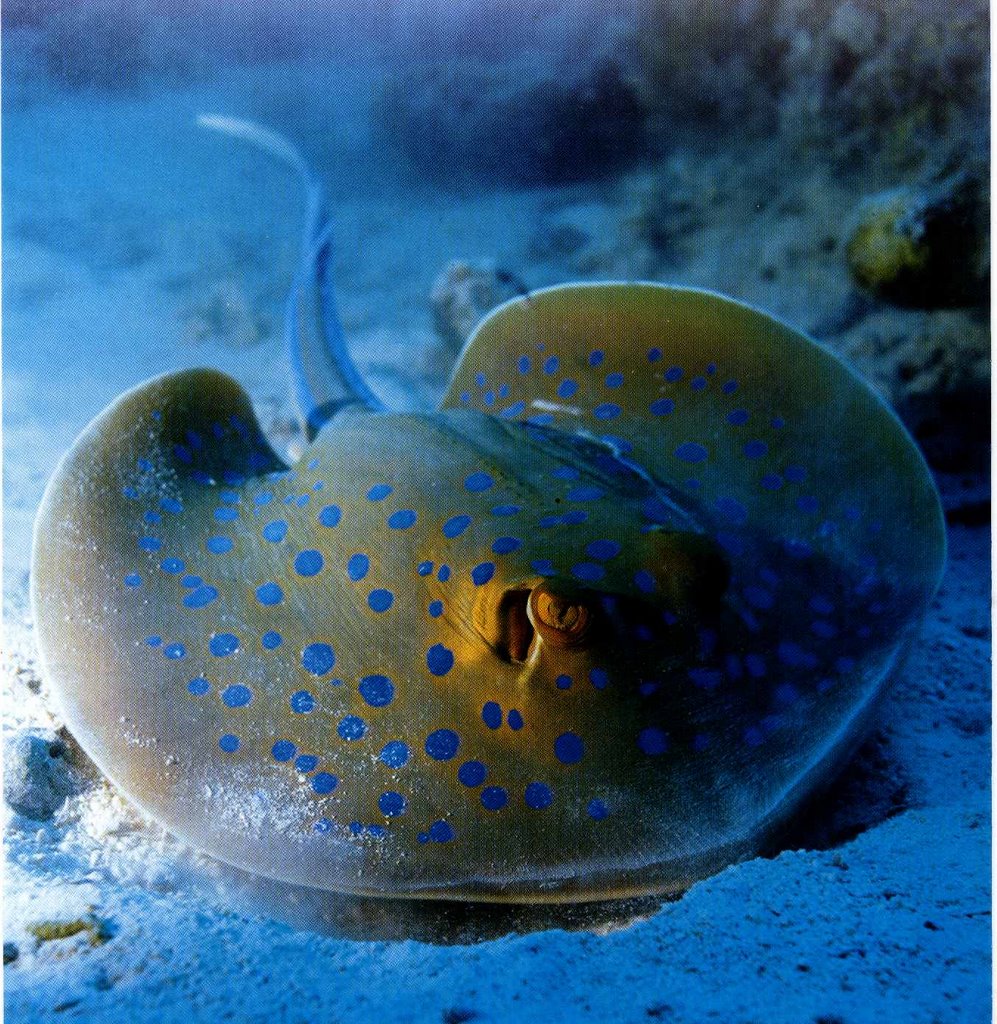
The Great Barrier Reef in the western Pacific Ocean, off the coast of Queensland, Australia is the largest coral reef in the world. It is also home to the stingray, a ‘camera-shy’ denizen which has been in the news recently for all the wrong reasons.
With a striking resemblance to the Stealth Fighter, this dark beauty glides like an hovercraft over the seabed by gently flapping its wing-like modified fins.
It spends most of its time at the bottom of the ocean because unlike most other fish, it does not have a swim bladder and therefore cannot float. As a result, it sinks to the seabed when it stops moving its fins.
The stingray uses the contrasting coloration of its skin to its advantage both, as predator and as prey!
When it lies prone on the seabed, its dark, mottled back merges with the murky background. At other times, it covers itself with a thin layer of sand by undulating its sides, making itself almost invisible.
When the stingray swims up to the surface, its light-colored belly provides perfect camouflage against the bright light that streams into the water from above.
Once a stingray has zeroed in on its prey, it uses its flattened body not only to trap it against the seabed but also to guide the prey to its mouth by undulating the edges of its body.
It uses the mottles on its back to advertise its venomous defenses, thus warning off predators like sharks and humans.
Like they say, ‘the sting is in the tail!’ The cartilaginous spine of the stingray runs along the body to form a tail with a sting at the base, with two venom-filled grooves underneath. When the ray lashes out at a victim, the delicate tail skin ruptures on impact, releasing the poison.
Most rays are gentle, only raising their tails in warning but some long-tailed rays attack if startled. Sadly, this is what happened out there on the Great Barrier Reef on the 4th of September 2006, when a ‘camera-toting’ denizen of Australia inadvertently swam over an inconspicuous ray.
With lightening-speed, the ray struck, its poisonous spine piercing the heart of Animal Planet’s first citizen and one of planet Earth’s greatest lovers of wildlife - Steve Irwin.
Copyright © 2006 Noël Gama


