
The Sundarbans jungle in South Bengal, is dark, deep and marshy with dense undergrowth of mangrove and thick overhang of trees. The sunlight penetrating the foliage from above, casts patterns of dappled light and shade - perfect camouflage for the Striped One.
As you venture further down the trail and into the gloom, you tend to get an eerie feeling of being watched. No road sign in the world is as effective as a pug mark on a trail. It will make your very heart stop! This is no Hollywood Walk of Fame - you are now in tiger country, home of the Royal Bengal Tiger!
The Bengal tiger has the classic orange coat with black stripes, a color variant being the white tiger which is hardly found in the wild.
Tigers usually hunt at night and rest during the day, often cooling off in rivers and pools.
Tigers hunt alone, stalking their prey or killing by ambush. They use their excellent eyesight and hearing for tracking prey in the dark. They stealthily slink up on the prey unseen till they are at a distance of about 65 feet and then charge with lightening speed using their powerful hind legs for the final leap.
The prey is knocked down with a single blow of the huge paws, lethal claws exposed. The heavily muscled shoulders and front limbs are designed for pulling down prey and the massive jaws with long canine teeth for stabbing the back of the neck and killing it. After the kill, the carcass is dragged into thick cover for feeding. The remains if any, are concealed with leaves for later consumption.
The Bengal tigers are poached for their valuable pelts as well as bones, teeth and penises for use in Chinese medicine. The tiger, at an estimated population of 1,200-1,500, is a gravely endangered species.
When I visited Dudhwa National Park in Uttar Pradesh way back in December 1992, I was not lucky enough to spot a tiger but I did meet Billy Arjan Singh (nicknamed ‘Billy’ - meaning ‘cat’ in Hindi - by his aunt because of his love for the big cats). This octogenarian is the second Indian to receive the prestigious J. Paul Getty Wildlife Conservation Award. A former member of the Steering Committee of Project Tiger, Billy spent his entire life working for the conservation of tigers.
Project Tiger founded in 1973 by the then Prime Minister, Indira Gandhi was an effort at saving the declining population of tigers in the country. The project was launched in the Corbett National Park, the first such sanctuary in the country, which celebrated its 70th anniversary during the National Wildlife Week, October 1st-7th, 2006.
Apparently, all is not well with Project Tiger, going by the spate of recent reports on its performance. The title of an article in the Times of India of 23rd September, 2006 aptly captures the scene at the end of my paper trail - ‘Project Tiger is paper tiger!’
Copyright © 2006 Noël Gama
Saturday, October 07, 2006
Tiger: National Animal of India


Thursday, September 14, 2006
Stingray - Master of Disguise
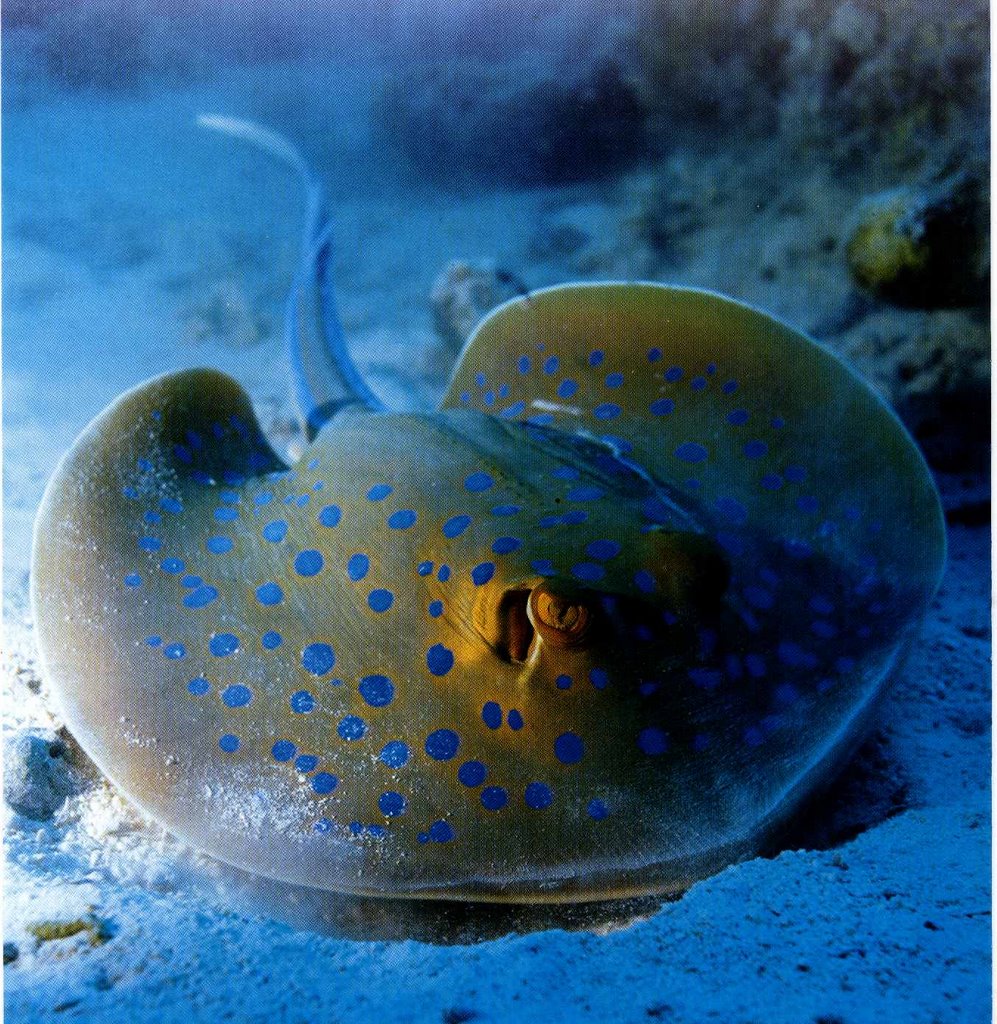
The Great Barrier Reef in the western Pacific Ocean, off the coast of Queensland, Australia is the largest coral reef in the world. It is also home to the stingray, a ‘camera-shy’ denizen which has been in the news recently for all the wrong reasons.
With a striking resemblance to the Stealth Fighter, this dark beauty glides like an hovercraft over the seabed by gently flapping its wing-like modified fins.
It spends most of its time at the bottom of the ocean because unlike most other fish, it does not have a swim bladder and therefore cannot float. As a result, it sinks to the seabed when it stops moving its fins.
The stingray uses the contrasting coloration of its skin to its advantage both, as predator and as prey!
When it lies prone on the seabed, its dark, mottled back merges with the murky background. At other times, it covers itself with a thin layer of sand by undulating its sides, making itself almost invisible.
When the stingray swims up to the surface, its light-colored belly provides perfect camouflage against the bright light that streams into the water from above.
Once a stingray has zeroed in on its prey, it uses its flattened body not only to trap it against the seabed but also to guide the prey to its mouth by undulating the edges of its body.
It uses the mottles on its back to advertise its venomous defenses, thus warning off predators like sharks and humans.
Like they say, ‘the sting is in the tail!’ The cartilaginous spine of the stingray runs along the body to form a tail with a sting at the base, with two venom-filled grooves underneath. When the ray lashes out at a victim, the delicate tail skin ruptures on impact, releasing the poison.
Most rays are gentle, only raising their tails in warning but some long-tailed rays attack if startled. Sadly, this is what happened out there on the Great Barrier Reef on the 4th of September 2006, when a ‘camera-toting’ denizen of Australia inadvertently swam over an inconspicuous ray.
With lightening-speed, the ray struck, its poisonous spine piercing the heart of Animal Planet’s first citizen and one of planet Earth’s greatest lovers of wildlife - Steve Irwin.
Copyright © 2006 Noël Gama


